

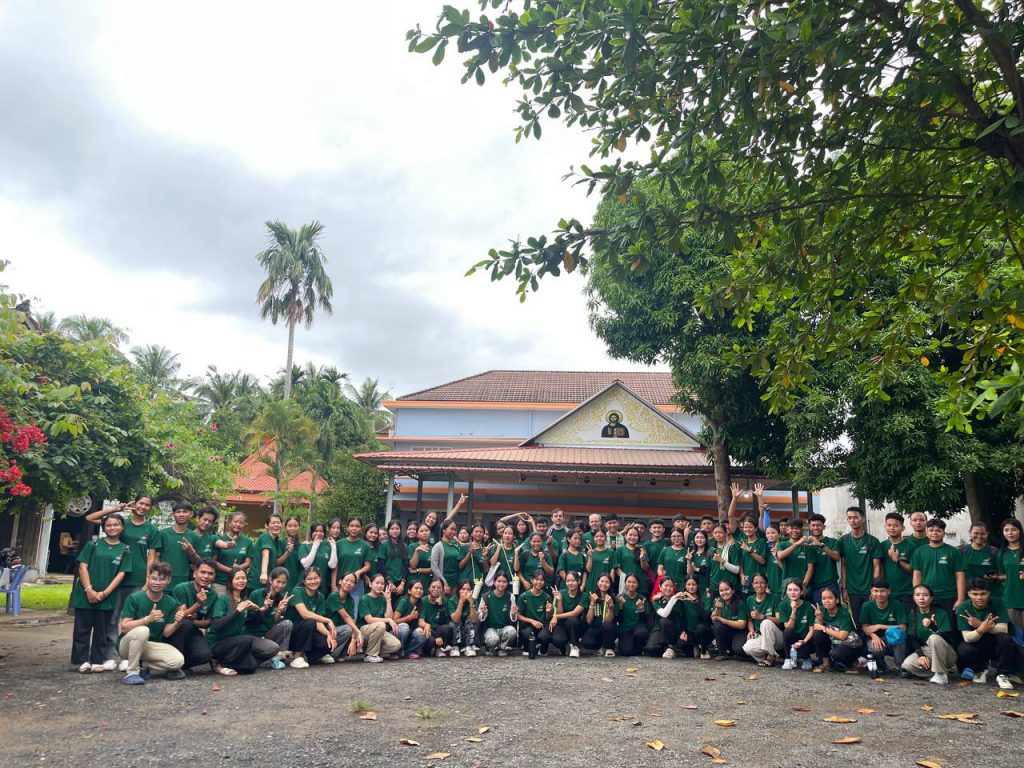
Père François avec groupe de jeunes pélerins
Together with the parish, we took advantage of a national 3-day holiday during the Festival of the Water to organise a pilgrimage on the theme of forgiveness. We travelled with 80 young people along the Mekong River, where we shared our experiences of reconciliation in small groups, and then listened to the moving video testimony of Maïti Girtanner, an 18-year-old resistance fighter during World War II who was tortured by a Nazi soldier whom she later forgave. The second day was devoted to a 12 kilometre walk to visit less-well-off families in a neighbouring parish. There, I was struck by the courage and kindness of our young people, most of whom had never walked so far or had ever had the opportunity to meet families living in poverty. Finally, the third day was more focused on relaxation, with swimming and then karaoke on the buses during the return trip to the capital. I think the theme of forgiveness was particularly well-chosen for these young people who have come from very different backgrounds and have been called to live together in our facilities. Currently, we have six catechism groups in the parish, many of which are young people from our facilities, but not exclusively: there are also children from new and recently converted Catholic families, as well as former Protestants. In this regard, I am always struck by the depth of faith of Protestants, who often know the Bible much better than our Catholics.
Synod on Catholic funerals
Working together with the Saint Irenaeus Interdiocesan Centre, which I manage, we organized a synod on Catholic funerals, following a similar session on marriage. On the first day, we listened to a former Buddhist monk, now working in the Ministry of Religious Affairs, speak about funerals according to Khmer culture. Then, on the second day, we listened to various speakers on how to celebrate Catholic funerals. On the third day, we reflected with Christians on how to organise Catholic funerals adapted to Cambodian culture. These days were very enriching for our communities, and this was all the more striking because we had set up an empty coffin as a backdrop. Next year, I plan to organize a similar session on the Eucharist. In fact, these sessions are all an opportunity for the Church to reflect on the direction we wish to give to the mission and to the proclamation of the Gospel to non-Christians.
Together with the MEP (Paris Foreign Missions Society), I had the opportunity to spend a week in Rome with the Permanent Council and the country group leaders to reflect on the Society’s direction. A crucial question arose: how can we ensure that the Church in Cambodia becomes more financially self-sufficient? This question is all the more pressing as we now have, for the first time since the war, an Apostolic Vicar of Cambodian nationality: Bishop Pierre Ly. His ordination was joyfully celebrated on September 6 in Phnom Penh, a truly historic date. This MEP session was followed by a jubilee with various interested colleagues, who also had the opportunity to meet Pope Leo. Subsequently, with the group of MEP priests in Cambodia, we met for three days, again at the home of one of our members, in Kratie, a small town along the Mekong River, known for its pink dolphins. After a boat trip and a relaxing first day, we gathered together on the second day to listen to Cambodian Catholic women speak about the community’s turbulent history during the dark years following the Khmer Rouge regime. We then visited the remains of the old church, which had been reclaimed by the government after the war. Later we listened to the parish priest speak about new Protestant communities wishing to convert to Catholicism due to various circumstances. This is not the first time this has happened: I would say that Protestants are pretty good at proclaiming Christ, but we often take over thanks to the richness of our tradition and liturgy. As for our MEP group, even though we are not religious living together in community, it is important to nurture our fellowship, especially to bear witness to the loving presence of the Risen Christ among us.
Au centre interdiocésain saint Irénée dont je suis responsable, après une session sur le mariage, nous avons cette fois-ci organisé un synode sur les funérailles catholiques.
The Acts of Love of Saint Thérèse
Together with the Saint-Justin diocesan catechist school, we went on a retreat to Eden, the diocesan retreat centre. The theme was the acts of love of Saint Thérèse of Lisieux. The retreat taught us how to love, especially those with whom we don’t necessarily get along, how to forgive, and how to pray according to God’s heart. I encourage you to reread manuscript C of *Story of a Soul*, where Thérèse describes her small, everyday acts of love with great subtlety and humour: it’s worth more than all the retreats and sermons in the world. It was a wonderful opportunity for us and the catechists to get to know each other better, but also to enjoy some quality time together at Phnom Voah, a kind of recreation centre founded by our bishop, before beginning a new and final year of studies. Our program is structured over two years: Friday evenings consist of a one-hour Bible study, and Saturday mornings are dedicated to three hours of theology, liturgy and sacraments, Church history, spiritual life, and a bit of philosophy. All of this is accompanied by meals shared in a convivial atmosphere, the Eucharist, and communal prayers. The challenge is to train Christian leaders who can keep on course in a society that is rapidly evolving towards atheism and the pursuit of wealth.
My seminary courses
Still on the theme of education, I continue to teach at the seminary. We have three young men in their propaedeutic year, where I teach the catechism of the Catholic Church; five first-year students, where I give introductory philosophy courses; and two young men who will be ordained deacons at the end of the year, to whom I teach the Prophets and Wisdom literature. All our courses are taught by local priests. To help us, we have been developing a new smartphone app for some years now: Catholic Faith Cambodia, where we bring together all official Church documents, numerous theology and philosophy courses, as well as many videos and interactive quizzes – all in Khmer, of course. The app also allows users to pray the Liturgy of the Hours and to read or listen to the daily readings. The Office of Readings will be published soon (a translation of over 600 pages!), for which I did, however, enlist the help of artificial intelligence. We are also producing short videos featuring our young people and the diocesan art school. We need to be creative if we want to proclaim the Gospel effectively.
Solidarity Initiatives
Finally, regarding community support activities, our St Lucy nursery school remains full: this year we are welcoming 115 children across three grade levels, which is always an opportunity for us to maintain ties with the neighbourhood. We also welcome 350 autistic children, with the ambitious project of developing a bakery adapted to their abilities, to better integrate them into Cambodian society, which is not very accepting of people with disabilities. Our St Vincent de Paul groups, for their part, visit families in need and organise games and hygiene training activities for impoverished street children. Finally, the St Elisabeth centre continues to receive many patients; the most recent one comes from Kompong Cham. He is a 27-year-old father who is paralysed from the waist down following a car accident. Abandoned by his wife and rejected by his family, he has only the Church left to help him and provide for his needs.
Fr François Hemelsdaël, MEP
