

 Why be a missionary in Japan today? The answer is simple. Of Japan’s 123 million inhabitants, only 1,031,000 people, or about 0.79% of the total population – that’s Catholics and Protestants combined – have been reached by the proclamation of the Gospel. The harvest is plentiful, but the labourers are dwindling, as the vocations crisis is hitting Japan hard. Missionaries from Europe and America have almost disappeared. Japanese priests are ageing, waiting for local replacements that are not coming forward. Even Japanese bishops are making way for foreign clergy. Much-needed help is coming from priests from Korea, Vietnam, Indonesia, Africa, and the Philippines. The Church in Japan is slowly becoming a pan-Asian Church.
When I arrived in Japan in 1977, there were eighty MEP missionaries. Today, there are only six of us, four of whom are over 77 years old. While becoming a missionary is vital to proclaim the Gospel, we can certainly ask ourselves how to be a missionary in today’s world. I firmly believe that living one’s faith openly is to be a missionary and a visible witness to the Gospel. We live in a world where modern technology and artificial intelligence are leading us toward an increasingly fascinating virtual world.
The early MEP missionaries of the Meiji era (1868-1912) had nothing to help them: no language school, no liturgical books translated into Japanese. Travelling on foot or horseback, they nevertheless succeeded in making our faith known and spread it throughout Japan. Over time, with a few rare exceptions, the MEP missionaries, while fostering and training a Japanese clergy, became parish priests and kindergarten directors. Even after Vatican II, the situation hardly changed.
When I arrived in Japan, I had to be resourceful to function as a missionary in a purely rural setting. Working with a few devout Christians, we chose to break away from parish structures in order to reach non-Christians. We began by organising free monthly conferences, bringing together about a hundred people to discuss various current topics. For young people, a summer camp that was open to everyone, Christian or not, and a music workshop where everyone made their own flute from a piece of bamboo, proved very popular.
I wrote several books and composed short plays with the help of non-Christian performers. I also created two oratorios, one about the prophet Jonah, the other about Saint Francis of Assisi. On several occasions we rented theatres that can accommodate more than eight hundred people to stage them. In this way, we succeeded in building relationships with a great many people and then many of them subsequently became Christians.
 As I got older, and with the advent of computers, cell phones, and so on, it became necessary to find new avenues for our missionary work and to think outside the box. So I started by creating a website, then a blog, and a YouTube channel, all imbued with an easily accessible missionary spirit. The wisdom lies in not forcing people to believe. By helping them to just encounter Christianity, we manage to interest as many as possible.
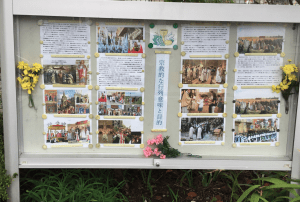
For over fifteen years, I have also created two missionary window displays, renewed monthly, with attractive decor and content. These displays face the street and allow passersby, as well as children from nearby elementary and high schools, to learn more about Christianity. The themes of the displays reflect current events, Japanese traditions, and the rhythm of the seasons, while also conveying short Bible verses. The simplest way to proclaim the Gospel is through art and beauty, without resorting to excessive proselytizing. Beauty, in all its forms, readily provides access to another kind of beauty, the beauty that comes from God.
I live alone on the large island of Awaji, surrounded by scattered Christians whom I only meet on Sundays. I cycle or walk. I’ve never owned a car, which is perfect for meeting people. Solitude doesn’t frighten me, and my very active imagination prevents me from being either inactive or idle.
As a missionary and a priest in charge of a parish, it is important to act in harmonious accordance with the plans of the bishop and the diocesan clergy. It is also necessary to maintain friendly relations with the people in one’s neighbourhood, and to strengthen existing ties with the various local Protestant Christian communities.
Since arriving in the Kansai region and the Archdiocese of Osaka, I am now the last and youngest missionary. My fellow missionaries are all over 84 years old. Two young men who came to join us have sadly abandoned their missionary vocation. Having no one with me to motivate me, help me reflect, renew my energy, or simply give me a boost is certainly detrimental. I, too, am waiting for someone to take over, who will undoubtedly come one day, but when?
So I put emphasis on the hope that must guide everything I do in the Church, along with the joy that comes from the activities and the energy required by my pastoral and missionary work. The stakes are high, and we mustn’t give up simply because we’re old. In any case, it’s not about trying things out to see if they work or not, but about giving it our all, and that takes a lot of effort…
‘Dare, dare again, always dare’, said Danton. This remains true for every missionary in the field, but also for all those who would like to join us. Even if, sooner or later, I become the only MEP in the Diocese of Osaka, I sincerely hope to serve this diocese and the mission in Japan for as long as possible. For this, I ask for your prayers, especially as this year, 2026, I will celebrate the 50th anniversary of my priestly ordination. Thank you.
Fr Gérard Gouineau, MEP
