

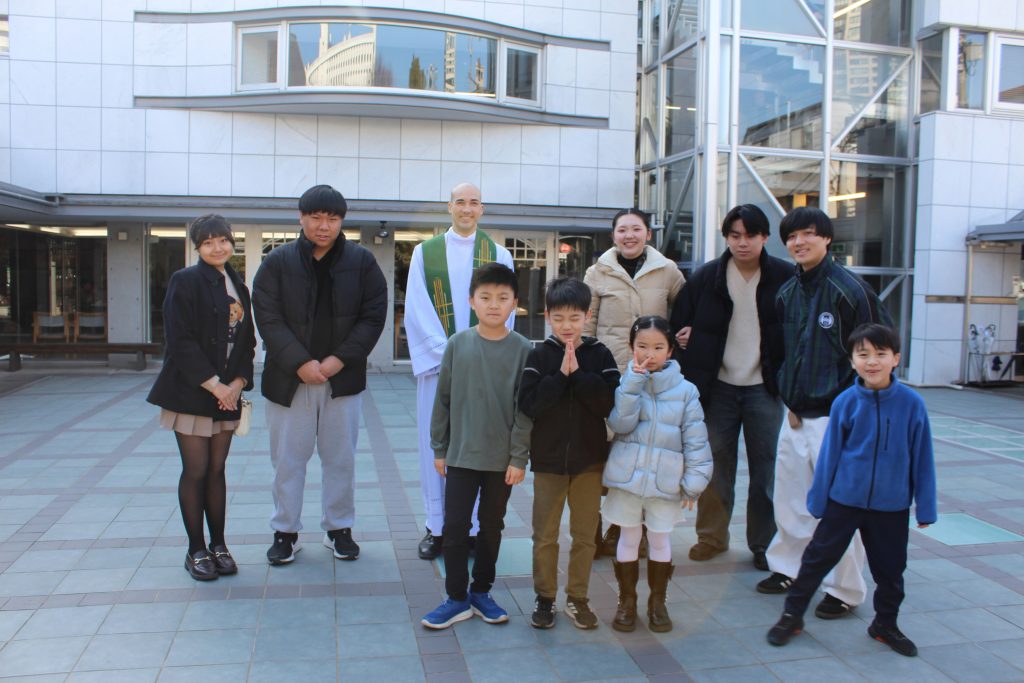
P. Alexandre, MEP avec les jeunes de la paroisse de Takanawa
Like all my colleagues in the Paris Foreign Missions, before receiving a mission from a local bishop, I must first learn the language of my host country. My case is somewhat unique as my initial plan was to go to Japan at the end of August 2025. A visa issue kept me in Paris until December. So it was in Paris, with the agreement of the MEP’s permanent council, that I began learning Japanese last September. This allowed me to acquire some basic knowledge without losing any time.
As you know, the patronal feast of the Foreign Missions Society is the Epiphany, which this year fell on January 4th, the day after my arrival in Japan. My fellow missionaries and I celebrated the Epiphany on January 5th. This occasion gave me the opportunity to meet some of my colleagues for the first time.
The very next day, accompanied by Yuri, the MEP secretary in Japan, who speaks fluent French and Japanese, we began the numerous administrative procedures required of foreigners settling in Japan.
I was very impressed by the Japanese people’s great sense of service. For a foreigner, dealing with Japanese government offices can be quite complicated.
The people who work in these offices meticulously follow each step of the procedures for various requests. They don’t bend the rules or take any shortcuts. However, despite this rigidity, these officials do everything they can to help people who come to them obtain what they need. In my case, the employees of these public services took all the time necessary to explain to Yuri and me what we needed to do to obtain each of the documents we required. I was impressed by their kindness and patience.
Once the initial administrative procedures were completed, I left the MEP regional house where I had been staying and moved into Saint Peter’s House. This house belongs to the Diocese of Tokyo and is home to retired priests and a few priests studying abroad. I am very happy to be living here.
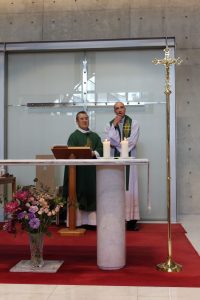
Avec le père Akaiwa ( ancien résident de la rue du Bac) dans sa paroisse à Takana
By my second week in Japan, I was able to resume my Japanese studies. While waiting to enrol in a language school where I can take intensive courses from next April, I am studying Japanese with a private tutor every morning. I have loved Japan since childhood, so I am very happy to be learning the language of this country. It’s a great opportunity.
The experience of studying Japanese here in Tokyo is very different from my experience in Paris that started in September 2025. Being able to speak, hear, and read Japanese every day makes it easier to acquire fluency in both speaking and writing.
However, unlike other Asian countries where opportunities to chat with locals abound, in Japan, it’s pretty much the opposite. Japanese people are always wary of bothering others, especially foreigners whose language they don’t speak. That’s why Japanese people almost never initiate a conversation with someone they don’t know.
Initiating Conversation: A Linguistic Challenge
This aspect of Japanese culture presents an additional challenge for those learning Japanese, as they are not always able to speak it as much as they would like. Also, with the proliferation of screens and automated services, it’s possible to spend several days in Japan, carrying out all your activities, without speaking to a single person.
This means that, to practise the language and improve your speaking skills, Japanese learners must create opportunities to interact and converse with Japanese people. So, I’ve found a few tricks. First, when I go to a shop, I almost always ask a salesperson for help, even when I don’t really need it. This way, I can not only speak but also work on my listening comprehension.
Then, after my meals in the St Peter’s house cafeteria, I always warmly thank the staff who prepared the meal and compliment them on their cooking. Sometimes, they happily chat with me for several minutes. They explain all sorts of things about Japanese cuisine, tell me about their families, give me advice on places to visit, and so on.
Finally, there’s also a supermarket in the neighbourhood that I go to almost every day. Even though I know it’s not really done in Japan, I play the gaikoku-jin card, that is, the foreigner card. When I go in, I always greet the supermarket employees whom I regularly see when I come to do my shopping very loudly and with a big smile. Last week, one of them started to recognise me and greeted me as well. From this week, we’ve also been exchanging a few polite phrases, and we’ll probably be able to have short conversations soon.
In short, by making a little effort to reach out to them, it’s possible to have small, everyday exchanges with Japanese people.
However, making Japanese friends is a challenge on a completely different level. It seems to me that Japanese society functions through ‘membership groups’. Each individual belongs to one or more groups: their university, their work team, the associations they belong to, their parish if they are Christian, and so on. It is within these groups that a person can meet people and build friendships that may or may not last a long time.
The problem for MEP missionaries arriving in Japan is that they don’t belong to any local group, since they don’t minister to the Japanese. And the group they belong to for their language learning consists almost entirely of foreigners. That’s why I’ve decided to start practising a Japanese sport – judo – from next month. By joining a club, I’ll be part of that club group, which will allow me to interact with Japanese people and build relationships.
Now I’d like to share a funny little anecdote with you. If you’ve ever lived abroad and learned the language of that country, you might have had a similar experience. Sometimes, knowing the meaning of words isn’t enough to understand a situation. You also need to understand how the locals do things.
The second week after arriving in Japan, I went to a shop to buy something, and that day, in addition to the self-checkout machines, there was one checkout staffed by a person. So I decided to go to that checkout to have an opportunity to speak Japanese. What I bought cost a little over 1,000 yen (about 5 euros). Since I didn’t have enough small change, I handed two 1,000-yen notes, totalling 2,000 yen, to the cashier. He said, ‘2,000 yen, yoroshii desu ka?’ Which means, literally, ‘2,000 yen, is that okay for you?’
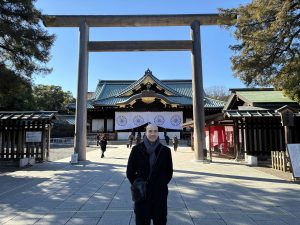
le père Alexandre devant le site de Yasukuni shrine, janvier 2026
I didn’t understand why he was asking me this question, since I had already paid enough money for my purchase. So, first, I double-checked that I had correctly read the price of my item and the amount of money I had given him. I hadn’t made a mistake. Then, I answered him, pointing to the two notes he was still holding: ‘Hai! 2000 yen desu!’ ‘Yes! That’s 2000 yen!’ Then, he started repeating the same thing two or three times, each time more slowly: ‘2000 yen! yoroshii desu ka?’ I repeated my answer each time: ‘Hai! 2000 yen desu!’ Finally, the cashier asked me in English if I authorised him to accept the 2000 yen. At that moment, I finally understood that in Japan, when you give money to a sales assistant, they sometimes ask you to confirm that you actually want to pay with that amount. This may be to give you a chance to check and get rid of your loose change, for example. So, if you ever come to Japan, don’t be surprised if a cashier doesn’t automatically accept the money you give them. If they ask if they can accept the amount you’ve given them, simply reply: ‘Hai! Onegai shimasu’.
Since arriving in Japan, I’ve been busy with administrative issues and my Japanese lessons, so I haven’t yet had much time for sightseeing. However, every Sunday I go to a different neighbourhood in Tokyo to attend Sunday Mass. This allows me not only to discover new places but also to get to know the priests and parishioners of the diocese where I’m currently residing.
Fr. Alexandre Rogala, MEP
[1] Reference to ‘Asie insolite’ [Unusual Asia], a series of short documentaries on Japanese culture that were broadcast by, among others, the J-One French television channel.
