

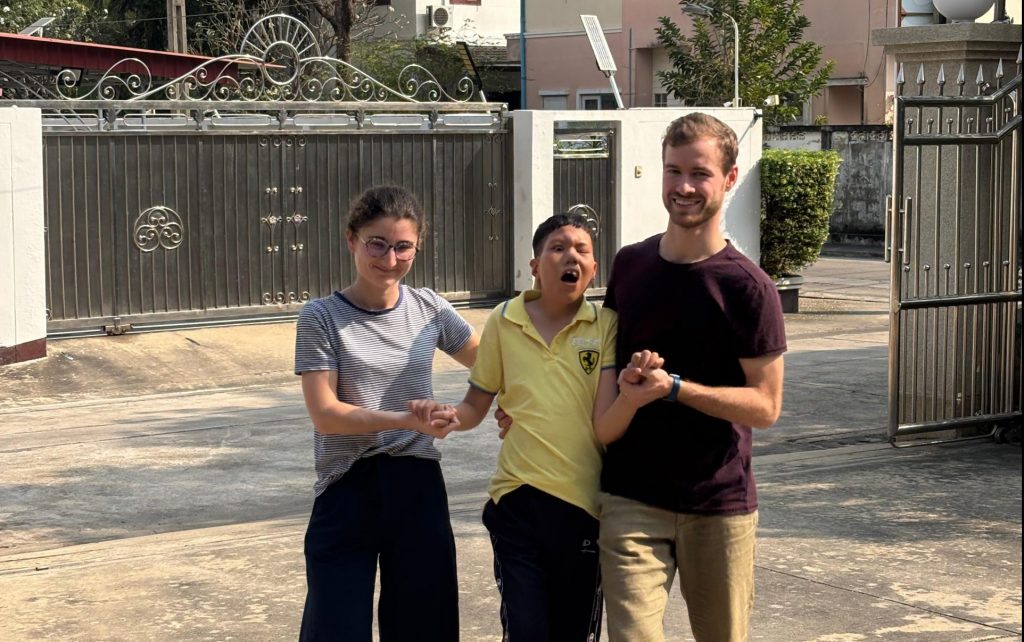
Mathilde, Uan, et Pierre-Louis pendant la promenade du matin.
We arrived in Thailand two months ago for a year-long mission at Angels’ Home, a centre that welcomes children and young adults with disabilities, as well as the mothers of some of them. On our first day, we were struck by the joy and love that pervade this unique place. The children at Angels’ Home have severe physical and mental disabilities, yet they seem incredibly happy. We quickly realized that this centre is an exception in Thailand and that most Thais with disabilities do not have such a peaceful and happy life as those at the centre. And this hasn’t always been the case even for the children of Angels’ Home…
Disability in Thailand
Thailand is deeply influenced by Buddhist culture, a religion practised by over 90% of the population. One of the fundamental principles of Buddhism is that life is governed by karma, meaning a chain of cause and effect. Nothing is left to chance. A good deed will be rewarded, while a bad deed will be punished, either in this life or a future one. Thus, disability is perceived as a consequence of past misdeeds, either in this life or a previous one. People with disabilities are therefore often rejected by society because Thais believe it is deserved, that it is their karma.
Almost all the disabled children at Angels’ Home have experienced or continue to experience this discrimination. One of them, for example, who is now 37 years old, lived for a long time with her family, who left her in a corner of a room where no one cared for her. She received no hygiene care and on some days was even deprived of food. Another, who currently lives at the centre, is visited by her mother only very rarely, as her mother seems very distant from her daughter, which is a great source of suffering for her. Several children at the centre are either orphans or abandoned by their families. This is due not only to Buddhist culture but also to the precarious situation of these families.
We experienced this discrimination ourselves when we went to the hospital with some of the children for a dentist appointment. Similarly, when we went to the beach with all the children from the centre, we noticed many questioning and insistent stares. In fact, apart from Angels’ Home and the parish, we never come across people with disabilities.
Angels’ Home, a place of salvation
For all these children with troubled lives, as well as for their mothers, Angels’ Home has proven to be a place of salvation, where they receive the care, attention, and love they need. The Catholic dimension of the centre plays a significant role. Indeed, many of the mothers and children at Angels’ Home were truly saved from their difficult and miserable lives by God through meeting Sister Angela, the nun who founded the centre. Almost all the mothers converted to Catholicism as a result of this experience. One of them was beaten by her husband. Several times, she forced him to leave, but each time, he returned and beat her again. Once at Angels’ Home, her husband wanted to come back again. She then turned to God, asking Him, if He exists, that her husband would leave once and for all. When her husband arrived, she told him to leave, which he did immediately, and he never returned. Following this, she requested baptism for herself and her two children. One of the mothers at the centre will also be baptised at Easter this year.
The centre functions so well, in part, because the mothers truly live by God’s love and love the children with that same love. One of the mothers expressed it this way: ‘We could care for the children simply out of duty. But we’re not like that. We put our whole heart into it; we do it with passion.’ God’s presence in our daily lives is particularly evident during morning prayer, when we share the Gospel reading for the day. Here’s what some mothers said during this prayer: ‘I thank God for healing me, something no doctor could have done,’ ‘Outsiders might wonder how we manage to live with such a situation, but I want to say that we are incredibly happy because we carry the image of Jesus Christ within us. Every smile, every gesture our child makes is truly the image of Jesus Christ. He is truly Lord in these children.’
Our daily lives
Angels’ Home consists of six mothers, nine ‘children’ aged 6 to 37, two staff members, and two nuns who run the centre. The MEP (Paris Foreign Missions Society) has been sending volunteers to this mission for eighteen months, and this is the first time they have sent a couple. Our daily life mainly involves participating in the mothers’ and children’s days through individual and group games, walks, physical exercise, and so on. Within this shared mission, we each have our own responsibilities.
Mathilde, a paediatric nurse, prepares treatments for each child and, on occasion, administers specific medications, changes dressings, or accompanies them to medical appointments. Mathilde also gives daily English lessons to Alissa, a 20-year-old woman at the centre who has a motor disability. This time spent together allows them to deepen their relationship, helps Alissa broaden her interests, and provides her with more stimulating activities in her daily life. Mathilde really enjoys these moments with Alissa. Often, the English lesson turns into a simple conversation in a joyful mix of Thai, English, and French, where they discuss the differences between their cultures, their families, their daily lives, and so on. In the long term, these English lessons also aim to guide Alissa toward greater independence, as she lives with her family in a shantytown and has few social interactions outside of the Angels’ Home community.
For his part, Pierre-Louis leads physical exercises with the heavier children who require more strength. He also helps with manual labour and maintenance at the centre alongside Khun, one of the staff members. Once a week, he goes to a shantytown to help a 60-year-old man, hemiplegic following a stroke, to walk — the only time this man gets out of bed during the week. A psychologist by training, Pierre-Louis is also setting up a support group for the mothers at the centre. The idea behind this group is to create a space for sharing and relaxation for the mothers, who are constantly called upon by their disabled children. The goal is to allow them to say what’s on their minds and to develop their inner resources.
The couple in the mission
Going on this mission as a couple is a real strength, because we can support each other. This means being able to share our joys and daily struggles with someone who understands the reality of what we are experiencing. Having each other is a firm basis that helps us stay motivated and give our all every day. Our partner is our sole support, which makes it even more important for us to care for one another and forgive each other when there is a disagreement. Our perspective on each other evolves when we see each other in a new environment, far removed from our daily lives in France. Being immersed together in a new culture and working with children with disabilities, a population we knew little or nothing about before, gives us an opportunity to discover more about each other and to be amazed by our partner. Finally, the simple and pure love we experience at Angels’ Home simplifies and purifies our marital love.
But living the mission as a couple also presents challenges. Indeed, despite the mental pressure and the physical and emotional energy the mission demands, it’s essential to remain attentive to each other. For us, this means sharing quality time together. Knowing when to put the mission aside to continue living our life as a couple allows us to give our all to the mothers and children.
Another challenge is finding our place within the mission, both as a couple and individually. We make sure to integrate ourselves individually with the mothers and children and not be together all the time, so that our status as a couple doesn’t hinder our connection with other people and we aren’t perceived as a self-sufficient ‘couple.’ Having different responsibilities and roles at Angels’ Home, as well as during our visits to the shantytowns several times a week, enriches our relationship and our conversations.
This mission is transforming us and our marriage. By living alongside the most vulnerable, we are discovering, each day, a simple joy and a love greater than ourselves. With God, we are also understanding that disability and difference do not diminish the value of a life, but reveal its full beauty and the capacity to love. Long live disability and long live difference!
Mathilde and Pierre-Louis Moret de Rocheprise, MEP volunteers in Thailand
